Diese Funktion ist rechts dargestellt. Es ist zu erkennen, dass an der Sprungstelle $r = 0$ der rechtsseitige Grenzwert gültig ist.
*This function is shown on the right.
*It can be seen that at the unit step point $r = 0$ the right-hand side limit is valid.
''Hinweise:''
*Die Aufgabe gehört zum Kapitel [[Stochastische_Signaltheorie/Verteilungsfunktion|Verteilungsfunktion]].
*Bezug genommen wird auch auf das Kapitel [[Stochastische_Signaltheorie/Wahrscheinlichkeitsdichtefunktion|Wahrscheinlichkeitsdichtefunktion]].
*Eine Zusammenfassung der hier behandelten Thematik bietet das Lernvideo [[Zusammenhang zwischen WDF und VTF]].
*Sollte die Eingabe des Zahlenwertes „0” erforderlich sein, so geben Sie bitte „0.” ein.
===Fragebogen===
Hints:
*The exercise belongs to the chapter [[Theory_of_Stochastic_Signals/Cumulative_Distribution_Function|Cumulative Distribution Function]].
*Reference is made to the chapter [[Theory_of_Stochastic_Signals/Probability_Density_Function|Probability Density Function]].
*The topic of this chapter is illustrated with examples in the (German language) learning video <br> [[Zusammenhang_zwischen_WDF_und_VTF_(Lernvideo)|"Zusammenhang zwischen WDF und VTF"]] $\Rightarrow$ "Relationship between PDF and CDF".
===Questions===
<quiz display=simple>
<quiz display=simple>
{Welche Eigenschaften einer Verteilungsfunktion (VTF) gelten allgemein, also nicht nur bei diesem konkreten Beispiel?
{What properties of the CDF hold when the random variable has no limits?
|type="[]"}
|type="[]"}
+ Die VTF steigt von $0$ auf $1$ zumindest schwach monoton an.
+ The CDF increases from $0$ to $1$ at least weakly monotonically.
- Die $F_x(r)$–Werte $0$ und $1$ sind für endliche $r$–Werte möglich.
- The $F_x(r)$ values $0$ and $1$ are possible for finite $r$ values.
+ Ein horizontaler Abschnitt weist darauf hin, dass in diesem Bereich die Zufallsgröße keine Anteile besitzt.
+A horizontal section indicates that in this range the random size has no proportions.
+Vertikale Abschnitte sind möglich.
+Vertical sections are possible.
{Wie groß ist die Wahrscheinlichkeit, dass $x$ positiv ist?
{What is the probability that $x$ is positive?
|type="{}"}
|type="{}"}
${\rm Pr}(x > 0) \ = $ { 0.25 3% }
${\rm Pr}(x > 0) \ = \ $ { 0.25 3% }
{Wie groß ist die Wahrscheinlichkeit, dass $|x|$ größer ist als $0.5$?
{What is the probability that $|\hspace{0.05cm}x\hspace{0.05cm}|$ is larger than $0.5$?
{Geben Sie die zugehörige WDF $f_x(x)$ allgemein und den Wert für $x = 1$ an.
{Specify the associated PDF $f_x(x)$ in general and the value for $x = 1$.
|type="{}"}
|type="{}"}
$f_x(x =1)\ = $ { 0.0677 3% }
$f_x(x =1)\ = \ $ { 0.0677 3% }
{Wie groß ist die Wahrscheinlichkeiten, dass $x$ genau gleich $1$ ist?
{What is the probability that $x$ is exactly equal to $1$ ?
|type="{}"}
|type="{}"}
${\rm Pr}(x = 1)\ = $ { 0. }
${\rm Pr}(x = 1)\ = \ $ { 0. }
{Wie groß ist die Wahrscheinlichkeiten, dass $x$ genau gleich $0$ ist?
{What is the probability that $x$ is exactly equal to $0$ ?
|type="{}"}
|type="{}"}
${\rm Pr}(x = 0)\ = $ { 0.5 3% }
${\rm Pr}(x = 0)\ = \ $ { 0.5 3% }
</quiz>
</quiz>
===Musterlösung===
===Solution===
{{ML-Kopf}}
{{ML-Kopf}}
'''(1)''' Die <u>Aussagen 1, 3 und 4</u> sind immer richtig:
'''(1)''' The <u>statements 1, 3 and 4</u> are always correct:
*Ein horizontaler Abschnitt in der VTF weist darauf hin, dass die Zufallsgröße in diesem Bereich keine Werte besitzt.
*A horizontal intercept in the CDF indicates that the random variable has no values in that region.
*Dagegen weist ein vertikaler Abschnitt in der VTF auf eine Diracfunktion in der WDF (an gleicher Stelle $x_0$) hin. Dies bedeutet, dass die Zufallsgröße den Wert $x_0$ sehr häufig annimmt, nämlich mit endlicher Wahrscheinlichkeit. Alle anderen Werte treten exakt mit der Wahrscheinlichkeit $0$ auf.
*In contrast, a vertical intercept in the CDF indicates a Dirac delta function in the PDF $($at the same location $x_0)$.
*Ist jedoch $x$ auf den Bereich von $x_{\rm min}$ bis $x_{\rm max}$ begrenzt, so ist $F_x(r) = 0$ für $r < x_{\rm min}$ und $F_x(r) = 1$ für $r > x_{\rm max}$. In diesem Sonderfall wäre auch die zweite Aussage zutreffend.
*This means that the random variable takes the value $x_0$ very frequently, namely with finite probability.
*All other values occur exactly with probability $0$.
*If, however $x$ is limited to the range from $x_{\rm min}$ to $x_{\rm max}$ then $F_x(r) = 0$ for $r < x_{\rm min}$ and $F_x(r) = 1$ for $r > x_{\rm max}$.
*In this special case, the second statement would also be true.
'''(2)''' The sought probability can be calculated from the difference of the CDF values at the boundaries:
'''(5)''' In the range around $1$ describes $x$ a continuous valued random variable.
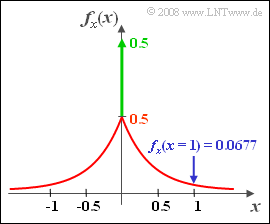
'''(4)''' Die WDF erhält man aus der zugehörigen VTF durch Differenzieren der zwei Bereiche. Es ergibt sich eine zweiseitige Exponentialfunktion sowie eine Diracfunktion bei $x = 0$:
*The probability that $x$ has exactly the value $1$ is therefore ${\rm Pr}(x = 1)\hspace{0.15cm}\underline{= \rm 0}.$
Der gesuchte Zahlenwert ist $f_x(x = 1)\hspace{0.15cm}\underline{= \rm 0.0677}$.
<i>Hinweis:</i> Für die zweiseitige Exponentialverteilung ist der Begriff „Laplaceverteilung” gebräuchlich.
'''(5)''' Im Bereich um $1$ beschreibt $x$ eine kontinuierliche Zufallsgröße. Die Wahrscheinlichkeit, dass $x$ exakt den Wert $1$ aufweist, ist deshalb ${\rm Pr}(x = 1)\hspace{0.15cm}\underline{= \rm 0}.$
'''(6)''' In $50\%$ der Zeit wird $x = 0$ gelten: ${\rm Pr}(x = 0)\hspace{0.15cm}\underline{= \rm 0.5}.$
'''(6)''' In $50\%$ of time $x = 0$ will hold: ${\rm Pr}(x = 0)\hspace{0.15cm}\underline{= \rm 0.5}.$
<i>Hinweise:</i> :
*The PDF of a speech signal is often described by a two-sided exponential function.
*Die WDF eines Sprachsignals wird häufig durch eine zweiseitige Exponentialfunktion beschrieben.
*The Dirac delta function at $x = 0$ mainly takes into account speech pauses – here in $50\%$ of all times.
*Die Diracfunktion bei $x = 0$ berücksichtigt vor allem Sprachpausen – hier in $50\%$ aller Zeiten.
{{ML-Fuß}}
{{ML-Fuß}}
[[Category:Aufgaben zu Stochastische Signaltheorie|^3.2 Verteilungsfunktion^]]
[[Category:Theory of Stochastic Signals: Exercises|^3.2 Cumulative Distribution Function^]]
[[de:Aufgaben:Aufgabe 3.2Z: Zusammenhang zwischen WDF und VTF]]
The topic of this chapter is illustrated with examples in the (German language) learning video "Zusammenhang zwischen WDF und VTF" $\Rightarrow$ "Relationship between PDF and CDF".
A horizontal intercept in the CDF indicates that the random variable has no values in that region.
In contrast, a vertical intercept in the CDF indicates a Dirac delta function in the PDF $($at the same location $x_0)$.
This means that the random variable takes the value $x_0$ very frequently, namely with finite probability.
All other values occur exactly with probability $0$.
If, however $x$ is limited to the range from $x_{\rm min}$ to $x_{\rm max}$ then $F_x(r) = 0$ for $r < x_{\rm min}$ and $F_x(r) = 1$ for $r > x_{\rm max}$.
In this special case, the second statement would also be true.
(2) The sought probability can be calculated from the difference of the CDF values at the boundaries: