[[File:P_ID2122__Mob_A_1_2.png|right|frame|WDF des Lognormal–Fadings]]
[[File:EN_Mob_A1_2.png|right|frame|PDF of lognormal fading]]
Wir betrachten eine Mobilfunkzelle im städtischen Bereich und ein Fahrzeug, das sich näherungsweise in einem festen Abstand $d_0$ von der Basisstation aufhält. Beispielsweise bewegt es sich auf einem Kreisbogen um die Basisstation.
We consider a mobile radio cell in an urban area and a vehicle that is approximately at a fixed distance $d_0$ from the base station. For example, it moves on an arc around the base station.
Somit ist der gesamte Pfadverlust durch folgende Gleichung beschreibbar:
Thus the total path loss can be described by the following equation:
*$V_0$ berücksichtigt den entfernungsabhängigen Pfadverlust, der mit $V_0 = 80 \ \rm dB$ als konstant angenommen wird.
*$V_0$ takes into account the distance-dependent path loss which is assumed to be constant: $V_0 = 80 \ \rm dB$ .
*Der Verlust $V_{\rm S}$ ist auf Abschattungen (<i>Shadowing</i>) zurückzuführen, der durch die Lognormal–Verteilung mit der Wahrscheinlichkeitsdichtefunktion
*The loss $V_{\rm S}$ is due to shadowing caused by the lognormal distribution with the probability density function (PDF)
* The transmit power is $P_{\rm S} = 10 \ \rm W$ $\text{(or } 40 \ \rm dBm$).
* Die Empfangsleistung soll mindestens $P_{\rm E} = 10 \ \rm pW$ (umgerechnet: $–80 \ \rm dBm$) betragen.
* The received power should be at least $P_{\rm E} = 10 \ \rm pW$ $\text{(or } -80 \ \rm dBm$)
Line 24:
Line 24:
''Hinweise:''
Notes:''
* Die Aufgabe gehört zum Kapitel [[Mobile_Kommunikation/Distanzabh%C3%A4ngige_D%C3%A4mpfung_und_Abschattung|Distanzabhängige Dämpfung und Abschattung]].
* This task belongs to the chapter [[Mobile_Communications/Distance_dependent_attenuation_and_shading|Distance dependent attenuation and shading]].
* Für das komplementäre Gaußsche Fehlerintegral können Sie folgende (grobe) Näherungen verwenden:
* You can use the following (rough) approximations for the complementary Gaussian error integral:
* Or use the interaction module [[Applets:Complementary_Gaussian_Error_Functions|Complementary Gaussian Error Functions]] provided by $\rm LNTwww$.
* Oder Sie benutzen das von $\rm LNTwww$ bereitgestellte Interaktionsmodul [[Applets:Komplementäre_Gaußsche_Fehlerfunktionen_(neues_Applet)|Komplementäre Gaußsche Fehlerfunktionen]].
===Fragebogen===
===Questions===
<quiz display=simple>
<quiz display=simple>
{Wäre $P_{\rm E}$ ohne Berücksichtigung des Lognormal–Fadings ausreichend?
{Would $P_{\rm E}$ be sufficient if the loss $V_S$ due to shadowing is not present?
|type="()"}
|type="()"}
+ Ja,
+ Yes,
- Nein.
- No.
{Die Lognormal–Parameter seien $m_{\rm S} = 20 \, \rm dB$ und $\sigma_{\rm S} = 0 \, \rm dB$. In wieviel Prozent der Zeit funktioniert das System?
{The parameters of the lognormal distribution are $m_{\rm S} = 20 \, \rm dB$ and $\sigma_{\rm S} = 0 \, \rm dB$. What percentage of the time does the system work?
{Wie groß darf $V_0$ maximal sein, damit die Zuverlässigkeit zu $99.9\%$ erreicht wird?
{How big can $V_0$ be at most, so that the reliability of $99.9\%$ is reached?
|type="{}"}
|type="{}"}
$V_0 \ = \ $ { 70 3% } $\ \rm dB$
$V_0 \ = \ $ { 70 3% } $\ \ \rm dB$
</quiz>
</quiz>
===Musterlösung===
===Solution===
{{ML-Kopf}}
{{ML-Kopf}}
'''(1)''' Richtig ist <u>JA</u>:
'''(1)''' The correct answer is <u>YES</u>:
*Aus dem $\rm dB$–Wert $V_0 = 80 \ \rm dB$ folgt der absolute (lineare) Wert $K_0 = 10^8$. Damit beträgt die Empfangsleistung
*From the $\rm dB$–value $V_0 = 80 \ \rm dB$ follows the absolute (linear) value $K_0 = 10^8$. Thus the received power is
*Gefordert ist aber lediglich der Grenzwert $–80 \ \rm dBm$.
*Only the limit value $-80 \ \rm dBm$ is required.
'''(2)''' Lognormal–Fading mit $\sigma_{\rm S} = 0 \ \rm dB$ ist gleichbedeutend mit einer konstanten Empfangslestung $P_{\rm E}$.
'''(2)''' Lognormal fading with $\sigma_{\rm S} = 0 \ \rm dB$ is equivalent to a constant received power $P_{\rm E}$.
*Gegenüber der Teilaufgabe '''(1)''' ist diese um $m_{\rm S} = 20 \ \rm dB$ kleiner ⇒ $P_{\rm E} = \ –60 \ \rm dBm$.
*Compared to the subtask '''(1)''' this is $m_{\rm S} = 20 \ \ \rm dB$ smaller ⇒ $P_{\rm E} = \ –60 \ \ \rm dBm$.
*Sie ist aber immer noch größer als der vorgegebene Grenzwert ($–80 \ \rm dBm$).
*But it is still greater than the specified limit value $(-80 \ \rm dBm)$.
*Daraus folgt: Das System ist (fast) zu <u>100% funktionsfähig</u>. „Fast” deshalb, weil es bei einer Gaußschen Zufallsgröße immer eine (kleine) Restunsicherheit gibt.
*It follows: The system is (almost) <u>100% functional</u>. "Almost" because with a Gaussian random quantity there is always a (small) residual uncertainty.
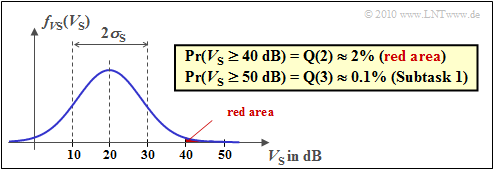
'''(3)''' Die Empfangsleistung ist dann zu gering (kleiner als $–80 \ \rm dBm$), wenn der Leistungsverlust durch den Lognormal–Term $40 \ \rm dB$ oder mehr beträgt.
'''(3)''' The received power is too low $($less than $–80 \ \rm dBm)$ if the power loss due to the lognormal–term is $40 \ \rm dB$ or more.
*Der veränderliche Anteil $V_{\rm S}$ darf also nicht größer sein als $20 \ \rm dB$.
[[File:EN_Mob_A_1_2c.png|right|frame|Loss due to lognormal fading]]
*Dargestellt ist hier die Wahrscheinlichkeitsdichte $f_{\rm VS}(V_{\rm S})$ des Pfadverlustes durch ''Shadowing'' (Longnormal–Fading).
*The probability density $f_{\rm VS}(V_{\rm S})$ of the path loss due to shadowing (Longnormal Fading) is shown here.
*Die Wahrscheinlichkeit, dass das System ausfällt, ist rot markiert:
<br clear=all>
*The probability that the system will fail is marked in red.
'''(4)''' Aus der Verfügbarkeitswahrscheinlichkeit $99.9 \%$ folgt die Ausfallwahrscheinlichkeit $10^{\rm –3} \approx \ {\rm Q}(3)$.
*Verringert man den entfernungsabhängigen Pfadverlust $V_0$ um $10 \ \rm dB$ auf $\underline {70 \ \rm dB}$, so kommt es erst dann zu einem Ausfall, wenn $V_{\rm S} ≥ 50 \ \rm dB$ ist.
*Damit wäre genau die geforderte Zuverlässigkeit erreicht, wie die folgende Rechnung zeigt:
We consider a mobile radio cell in an urban area and a vehicle that is approximately at a fixed distance $d_0$ from the base station. For example, it moves on an arc around the base station.
Thus the total path loss can be described by the following equation:
The probability density $f_{\rm VS}(V_{\rm S})$ of the path loss due to shadowing (Longnormal Fading) is shown here.
The probability that the system will fail is marked in red.
(4) From the availability probability $99.9 \%$ follows the failure probability $10^{\rm -3} \approx \ {\rm Q}(3)$.
If the distance-dependent path loss $V_0$ is reduced by $10 \ \ \rm dB$ to $\underline {70 \ \rm dB}$, a failure will only occur when $V_{\rm S} ≥ 50 \ \ \rm dB$.
This would achieve exactly the required reliability, as the following calculation shows: