(2 intermediate revisions by the same user not shown)
Line 21:
Line 21:
Hints:
Hints:
*The exercise belongs to the chapter [[Information_Theory/Verschiedene_Entropien_zweidimensionaler_Zufallsgrößen|Different entropies of two-dimensional random variables]].
*The exercise belongs to the chapter [[Information_Theory/Verschiedene_Entropien_zweidimensionaler_Zufallsgrößen|Different entropies of two-dimensional random variables]].
*In particular, reference is made to the pages <br> [[Information_Theory/Verschiedene_Entropien_zweidimensionaler_Zufallsgrößen#Conditional_probability_and_conditional_entropy|Conditional probability and conditional entropy]] as well as <br> [[Information_Theory/Verschiedene_Entropien_zweidimensionaler_Zufallsgrößen#Mutual_information_between_two_random_variables|Mutual information between two random variables]].
*In particular, reference is made to the pages <br> [[Information_Theory/Different_Entropy_Measures_of_Two-Dimensional_Random_Variables#Conditional_probability_and_conditional_entropy|Conditional probability and conditional entropy]] as well as <br> [[Information_Theory/Different_Entropy_Measures_of_Two-Dimensional_Random_Variables#Mutual_information_between_two_random_variables|Mutual information between two random variables]].
We consider the tuple $Z = (X, Y)$, where the individual components $X$ and $Y$ each represent ternary random variables ⇒ symbol set size $|X| = |Y| = 3$. The joint probability function $P_{ XY }(X, Y)$ is sketched on the right.
In this exercise, the following entropies are to be calculated:
the "joint entropy" $H(XY)$ and the "mutual information" $I(X; Y)$,
the "joint entropy" $H(XZ)$ and the "mutual information" $I(X; Z)$,
the two "conditional entropies" $H(Z|X)$ and $H(X|Z)$.
(2) The random variables $X$ and $Y$ are statistically independent because of $P_{ XY }(⋅) = P_X(⋅) · P_Y(⋅)$ .
From this follows $I(X, Y)\hspace{0.15cm}\underline{ = 0}$.
The same result is obtained by the equation $I(X; Y) = H(X) + H(Y) - H(XY)$.
Probability mass function of the random variable $XZ$
(3) If one interprets $I(X; Z)$ as the remaining uncertainty with regard to the tuple $Z$, when the first component $X$ is known, then the following obviously applies:
In purely formal terms, this task can also be solved as follows:
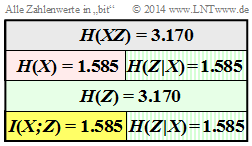
The entropy $H(Z)$ is equal to the joint entropy $H(XY) = 3.17 \ \rm bit$.
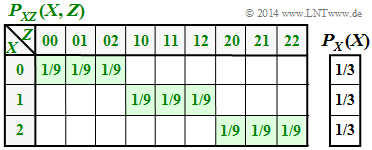
The joint probability $P_{ XZ }(X, Z)$ contains nine elements of probability $1/9$, all others are occupied by zeros ⇒ $H(XZ) = \log_2 (9) = 3.170 \ \rm bit $.
Thus, the following applies to the mutual information of the random variables $X$ and $Z$: