(2 intermediate revisions by the same user not shown)
Line 18:
Line 18:
*The lower bound $H(X) = 0$ results when any probability $p_\mu = 1$ and all others are zero.
*The lower bound $H(X) = 0$ results when any probability $p_\mu = 1$ and all others are zero.
*The upper bound is to be derived here as in the lecture "Information Theory" by [[Biographies_and_Bibliographies/Lehrstuhlinhaber_des_LNT#Prof._Dr._sc._techn._Gerhard_Kramer_.28seit_2010.29|Gerhard Kramer]] at the TU Munich:
*The upper bound is to be derived here as in the lecture "Information Theory" by [[Biographies_and_Bibliographies/Chair_holders_of_the_LNT_since_1962#Prof._Dr._sc._techn._Gerhard_Kramer_(since_2010)|Gerhard Kramer]] at the TU Munich:
[[File:P_ID2755__Inf_A_3_3_B_neu.png|right|frame|Upper bound estimate for the natural logarithm]]
[[File:P_ID2755__Inf_A_3_3_B_neu.png|right|frame|Upper bound estimate for the natural logarithm]]
:* By extending the above equation by $|X|$ in the numerator and denominator, using $\log_2 \hspace{0.05cm}x= \ln(x)/\ln(2)$, we obtain:
:* By extending the above equation by $|X|$ in the numerator and denominator, using $\log_2 \hspace{0.05cm}x= \ln(x)/\ln(2)$, we obtain:
Line 34:
Line 34:
Hints:
Hints:
*The exercise belongs to the chapter [[Information_Theory/Einige_Vorbemerkungen_zu_zweidimensionalen_Zufallsgrößen|Some preliminary remarks on 2D random variables]].
*The exercise belongs to the chapter [[Information_Theory/Einige_Vorbemerkungen_zu_zweidimensionalen_Zufallsgrößen|Some preliminary remarks on 2D random variables]].
*In particular, reference is made to the page [[Information_Theory/Einige_Vorbemerkungen_zu_zweidimensionalen_Zufallsgrößen#Wahrscheinlichkeitsfunktion_und_Entropie|Probability function and entropy]].
*In particular, reference is made to the page [[Information_Theory/Some_Preliminary_Remarks_on_Two-Dimensional_Random_Variables#Probability_mass_function_and_entropy|Probability function and entropy]].
*The same constellation is assumed here as in [[Aufgaben:Aufgabe_3.2:_Erwartungswertberechnungen|Exercise 3.2]].
*The same constellation is assumed here as in [[Aufgaben:Aufgabe_3.2:_Erwartungswertberechnungen|Exercise 3.2]].
*The equation of the binary entropy function is:
*The equation of the binary entropy function is:
:$$H_{\rm bin}(p) = p \cdot {\rm log}_2 \hspace{0.1cm} \frac{1}{p} +
*By setting this derivative to zero, we obtain the abscissa value $p = 0.5$, which leads to the maximum of the entropy function: $H_{\rm bin}(p =0.5) = 1$ bit <br>⇒ the proposed solution 2 is wrong.
*By setting this derivative to zero, we obtain the abscissa value $p = 0.5$, which leads to the maximum of the entropy function: $H_{\rm bin}(p =0.5) = 1$ bit <br>⇒ the proposed solution 2 is wrong.
*By differentiating again, one obtains for the second derivative
*By differentiating again, one obtains for the second derivative
\frac{-1}{{\rm ln}(2) \cdot p \cdot (1-p)} \hspace{0.05cm}.$$
*This function is negative in the entire definition domain $0 ≤ p ≤ 1$ ⇒ $H_{\rm bin}(p)$ is concave ⇒ the proposed solution 1 is correct.
*This function is negative in the entire definition domain $0 ≤ p ≤ 1$ ⇒ $H_{\rm bin}(p)$ is concave ⇒ the proposed solution 1 is correct.
Line 103:
Line 96:
* For $p = 0$ one obtains the probability function $P_X(X) = \big [\hspace{0.05cm}0\hspace{0.05cm}, \hspace{0.15cm} 1/2\hspace{0.05cm},\hspace{0.15cm} 1/2 \hspace{0.05cm} \big ]$ ⇒ $H(X) = 1$ bit.
* For $p = 0$ one obtains the probability function $P_X(X) = \big [\hspace{0.05cm}0\hspace{0.05cm}, \hspace{0.15cm} 1/2\hspace{0.05cm},\hspace{0.15cm} 1/2 \hspace{0.05cm} \big ]$ ⇒ $H(X) = 1$ bit.
* The maximum under the condition $p_3 = 1/2$ is obtained for $p_1 = p_2 = 1/4$:
* The maximum under the condition $p_3 = 1/2$ is obtained for $p_1 = p_2 = 1/4$:
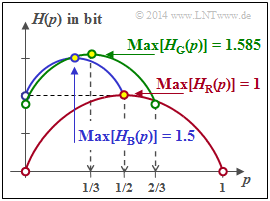
On the right you see the entropy functions $H_{\rm R}(p)$, $H_{\rm B}(p)$ and $H_{\rm G}(p)$, where $\rm R$ stands for "red", $\rm B$ for "blue" and $\rm G$ for "green". The probability functions are for all random variables:
In Exercise 3.2 the expected value ${\rm E} \big [\log_2 \hspace{0.05cm} {1}/{P_X(X)} \big ] =|X|$ was calculated for the case $p_\mu \ne 0$ for all $\mu$ . Thus, the first term disappears and the known result is obtained:
By setting this derivative to zero, we obtain the abscissa value $p = 0.5$, which leads to the maximum of the entropy function: $H_{\rm bin}(p =0.5) = 1$ bit ⇒ the proposed solution 2 is wrong.
By differentiating again, one obtains for the second derivative
This function is negative in the entire definition domain $0 ≤ p ≤ 1$ ⇒ $H_{\rm bin}(p)$ is concave ⇒ the proposed solution 1 is correct.
Three entropy functions with $M = 3$
(3)Propositions 1 and 2 are correct here:
For $p = 0$ one obtains the probability function $P_X(X) = \big [\hspace{0.05cm}0\hspace{0.05cm}, \hspace{0.15cm} 1/2\hspace{0.05cm},\hspace{0.15cm} 1/2 \hspace{0.05cm} \big ]$ ⇒ $H(X) = 1$ bit.
The maximum under the condition $p_3 = 1/2$ is obtained for $p_1 = p_2 = 1/4$: